About Ragdolls
The Ragdoll Cat
A large, semi-longhaired cat with blue eyes and a pointed coat, developed in California in the 1960s and known for going limp when picked up. This page is written from our own cats: what they are like to live with, how big they get, what the coat needs, what they eat, and what they need from a home. The short version is that a Ragdoll is a dog-shaped cat, and that is either exactly what you want or not what you want at all.
Temperament
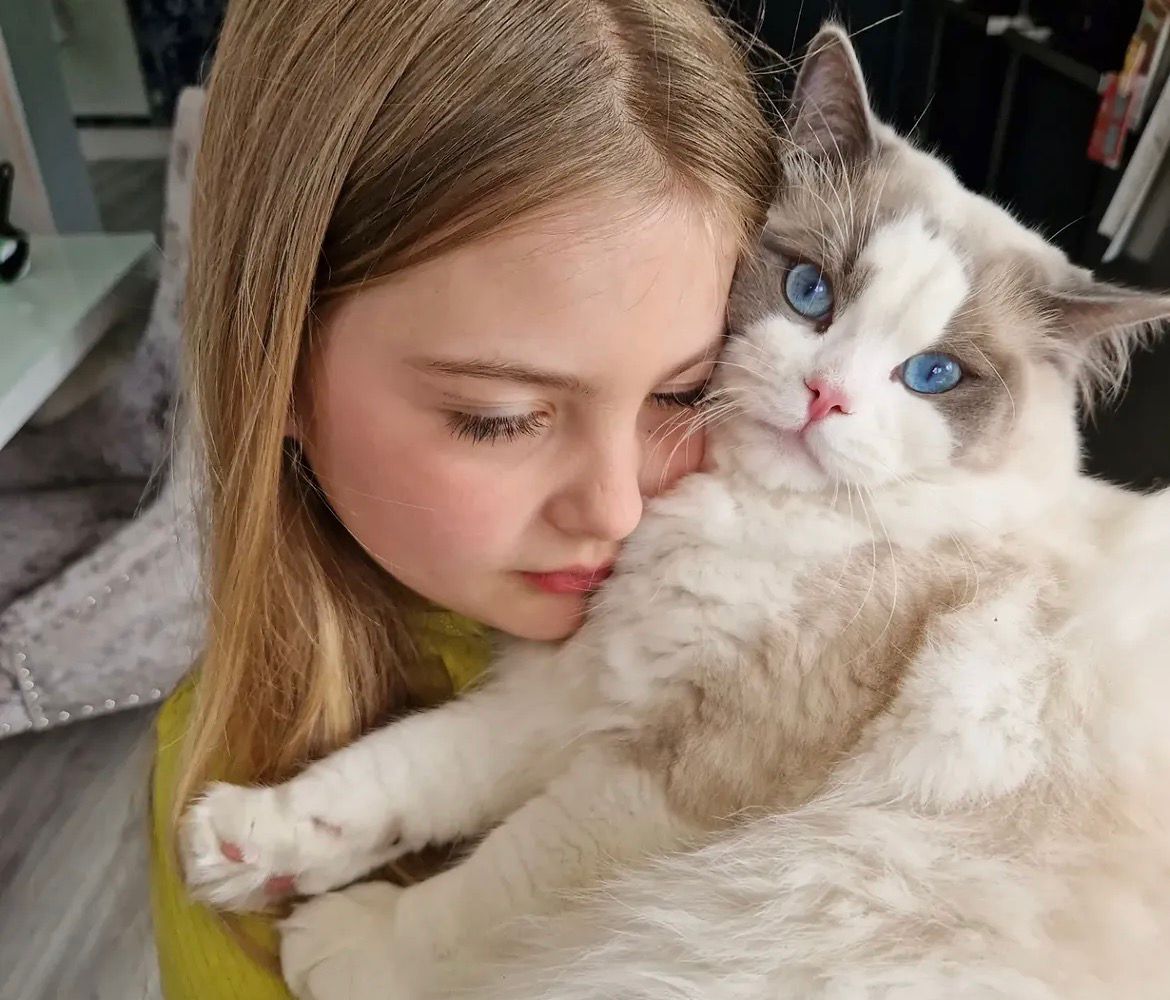
Ragdolls follow you. Ours walk from room to room behind whoever is moving, sit on the edge of the bath, sleep on the bed, and go to the door when the doorbell rings. They are quiet cats with a small voice they use sparingly. They are patient with children in a way most cats are not, and they will let themselves be carried about like a doll, which is where the name came from. They settle with a dog if the dog is calm and the introduction is slow.
The other side of the same coin: a Ragdoll does not do well alone all day, every day. They are bred to be with people, and a Ragdoll left in an empty house from eight until six becomes withdrawn in a way that takes months to undo. If nobody is home most days, two Ragdolls together are happier than one, and we say so before we sell one.
They are not hunters, not climbers, and not streetwise. A Ragdoll will walk up to a strange dog, or a car, with the same trust it shows you. They should live indoors, with a secure enclosure or a catio if you want them to have the sun.
Size and growth
Ragdolls are one of the largest domestic breeds. Males finish at thirteen to twenty pounds and females at four to six, but they take three to four years to get there, which surprises people who expect a cat to be grown at one. A one-year-old Ragdoll is a gangly adolescent. The chest broadens and the coat fills out in the second and third years, and the fatty pad on the lower belly that the breed standard asks for appears around then and is not fat. Weights by age from our own cats.
The coat
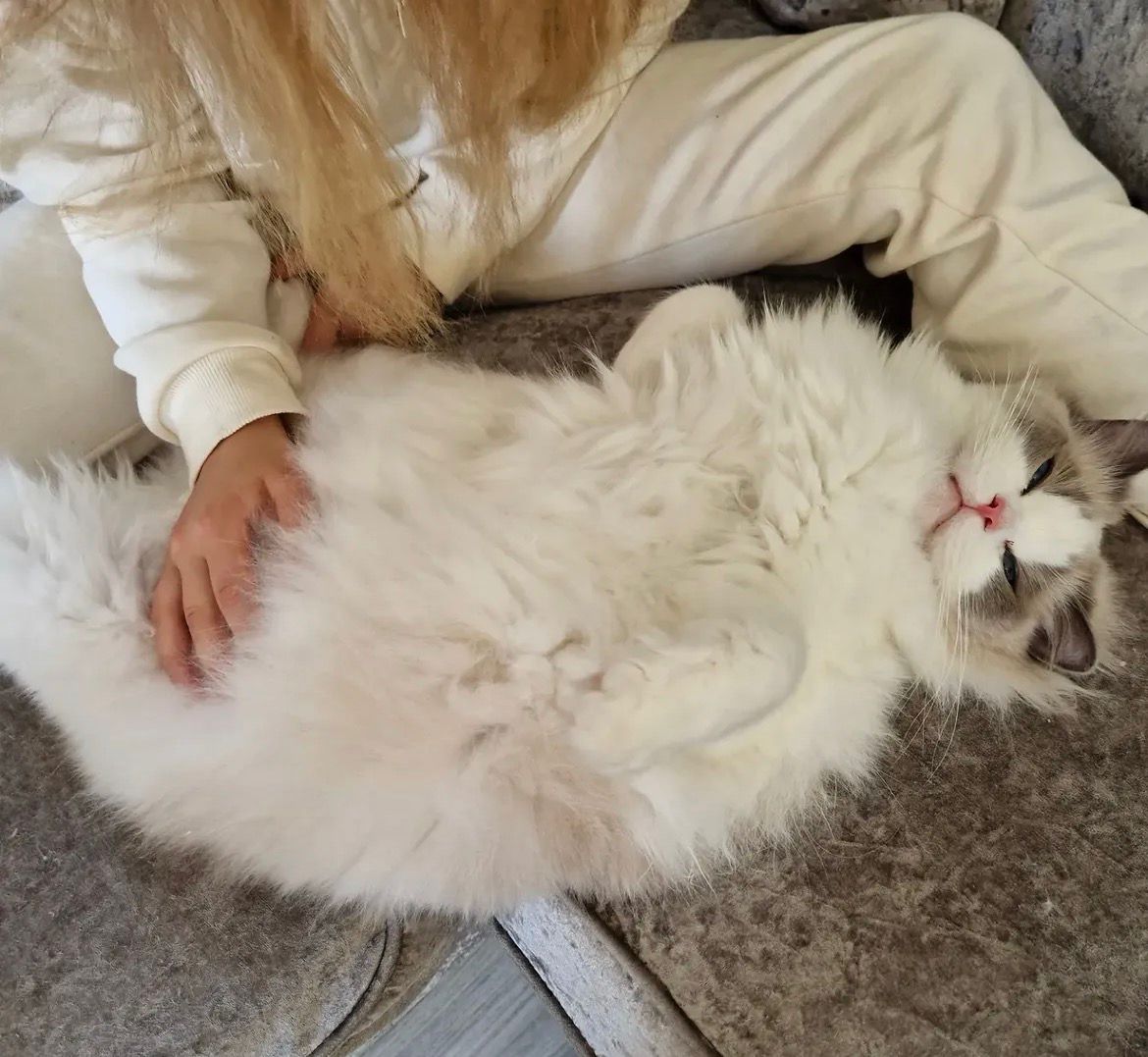
Semi-long, silky, and with very little undercoat, which is why a Ragdoll mats less than it looks like it should and sheds less than a Persian or a Maine Coon. A brush twice a week is enough for most of the year; daily for a fortnight when the winter coat drops in spring. The places that mat are behind the ears, under the arms and the trousers, and a small slicker or a steel comb reaches them. Ragdolls rarely need bathing. The coat and shedding in full.
Color and pattern
Every Ragdoll is a pointed cat: the color is restricted to the cooler parts of the body, the face, the ears, the legs and the tail, by a gene that only works below body temperature. That is why kittens are born white and color up over weeks, and why an adult keeps darkening for years. The colors are seal, blue, chocolate, lilac, flame and cream, and the patterns are colorpoint, mitted and bicolor, with lynx and tortie as overlays. The eyes are always blue in a pointed Ragdoll. The colors, with our own cats as the examples.
Health
A Ragdoll is a robust cat with two inherited conditions the breed is known for: hypertrophic cardiomyopathy, a thickening of the heart muscle, and polycystic kidney disease. Both have DNA tests and both are questions to ask any breeder directly, including us. Beyond those, the risks are a house cat's risks: weight, dental disease in middle age, and the road. Twelve to seventeen years is the usual lifespan and some reach twenty. What shortens and lengthens a Ragdoll life.
Feeding
A meat-based diet, wet and dry, with raw meat a few times a week if you are comfortable handling it, fed by weight rather than by appetite once the cat is a year old. Ragdolls are not greedy cats as a rule but they are large, slow-moving and indoor, and two pounds of extra weight on a Ragdoll is a burden on the heart the breed can least afford.
What a Ragdoll needs from a home
- Company for most of the day, or a second cat.
- Indoor life, with a window to sit in and, ideally, an enclosure.
- A tall scratching post from the first day.
- Somewhere high to sleep and somewhere soft to flop.
- A brush twice a week and someone patient enough to use it.
- Fifteen years.
Is a Ragdoll right for you?
If you want a cat that comes when it is called, greets you at the door, lies across your lap through a film and lets a child carry it about, yes. If you want a cat that entertains itself, hunts, and asks nothing of you, no, and we would rather tell you that now. The personality, in full.